 How-to
How to Manage Wedding Day Logistics Without the Stress
Last Updated: October 30, 2026
Quick Summary
Manage wedding day logistics by building a timeline backward from the ceremony start, adding buffer time for vendor load-in, ceremony transitions, and portraits. Share a master schedule and vendor contact list with everyone, and write a setup and teardown checklist with named owners.
- Build in a 10-minute cushion before the processional because guests arrive late.
- Add 30 extra minutes for vendor load-in and 15 minutes between ceremony and cocktail hour.
- Set up rentals and structure first, then linens, then centerpieces, then signage.
- Do a final walkthrough 30 minutes before guests arrive to check sightlines and hazards.
- Venue contracts often set a hard load-out deadline of midnight or 1:00 AM with hourly overtime.
Table of Contents
- Building a Wedding Day Timeline That Actually Holds
- Wedding Vendor Coordination From Load-In to Handoff
- Your Wedding Setup and Teardown Checklist
- Wedding Party Logistics and Guest Flow
- Planning for Weather, Accessibility, and the Unexpected
- Hand Off Your Wedding Day Logistics to CANA EVENTS
- Frequently Asked Questions
Building a Wedding Day Timeline That Actually Holds
Learning how to manage wedding day logistics starts with one document: a timeline that survives contact with reality. The schedules that hold are built backward from the ceremony.
Working Backward From the Ceremony Start
Set the ceremony time first, then subtract. Work back through portraits, first look, getting ready, and vendor arrivals.
Don't schedule the ceremony at the exact minute you want it to begin. Guests arrive late and grandparents need help seating, so build in a 10-minute cushion before the processional.
Where to Add Buffer Time
Buffer time belongs at three points:
- Vendor load-in: 30 extra minutes for setup surprises
- Ceremony transition: 15 minutes between ceremony end and cocktail hour
- Portraits: 10 minutes per group photo block
Wedding Vendor Coordination From Load-In to Handoff
Wedding vendor coordination runs on one rule: every vendor knows where to go, when to arrive, and who to call.
Venue load-in is where chaos usually starts. Photographers, florists, and the band all want the same door at the same time.
The Master Schedule and Vendor Contact List
Build two documents and share both with every vendor:
| Document | What It Contains | Who Gets It |
|---|---|---|
| Master schedule | Every arrival, setup, and start time | All vendors |
| Vendor contact list | Names, roles, phone numbers | All vendors and your coordinator |
Your Wedding Setup and Teardown Checklist
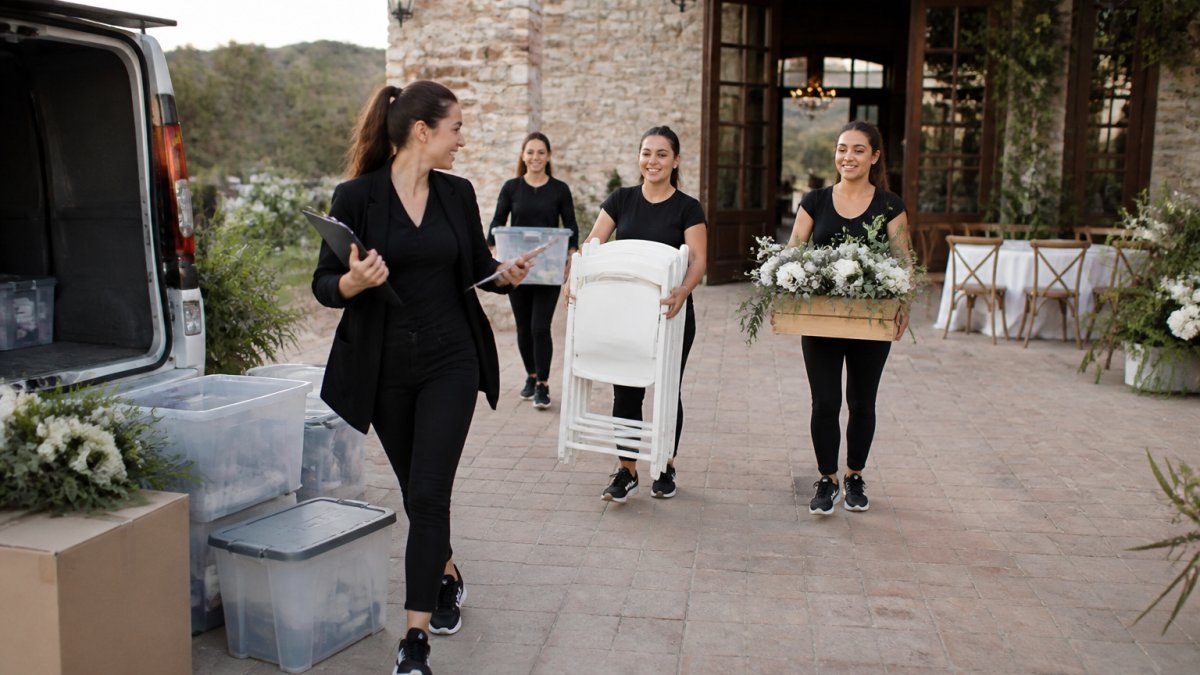
A wedding setup and teardown checklist turns a pile of decor into a repeatable process. Write it once, assign names, and share it with your setup crew.
The Setup Sequence That Prevents Rework
Setup order matters because each layer depends on the one below it. Build the schedule in this sequence and give each block a start time and an owner:
- Rentals and structure first. Tables, chairs, staging, and tenting land before anything decorative touches the floor. If your rental delivery window is 8:00 AM, your florist cannot start at 8:00 AM.
- Linens and base layers. Tablecloths, chair covers, and runners go down once tables are placed and leveled.
- Centerpieces and florals. These go last among table decor so they aren't moved twice.
- Signage, place cards, and welcome table. These are the final 30-minute items because they're the most likely to be rearranged.
- Final walkthrough 30 minutes before guests arrive. Walk the guest path from parking to seat with fresh eyes. Check sightlines, trip hazards, and that every candle is actually lit.
The Load-Out Plan You Write Before the Wedding
Post-wedding logistics are the most ignored part of the day. Venue contracts commonly set a hard load-out deadline, often midnight or 1:00 AM, and charge hourly overtime if you miss it. That deadline, not the party, dictates your teardown plan.
Build a load-out sheet with four columns: item, owner, destination, and deadline. Then assign by category, not by person-who-happens-to-be-nearby:
- Rentals: Confirm in writing whether the rental company picks up that night, the next morning, or whether you're responsible for stacking and staging. Many contracts require chairs stacked and linens bagged in a specific spot.
- Decor and personal items: Assign one person, not the couple, to collect signage, centerpieces, gifts, and the card box. Give them a labeled bin per category.
- Gifts and cards: Designate a locked vehicle or a responsible party who takes the card box home that night. Do not leave it in a venue office.
- Florals: Decide in advance what gets donated, what goes home, and what the florist reclaims. Florists often want vases and stands back the same night.
Handling Site Resets and Table Turnover
If your ceremony and reception share a space, plan the reset in writing. Table turnover needs a start time, a crew, and a staging area for chairs. Build that window into the cocktail hour, not on top of it.
Give the reset crew a printed diagram of the reception layout so they aren't guessing where tables go.
Wedding Party Logistics and Guest Flow
Wedding party logistics come down to movement: who walks when, where they stand, and how they exit. Guest flow follows the same logic at a larger scale.
Planning for Weather, Accessibility, and the Unexpected
Weather contingency and venue accessibility are the two plans couples skip, then wish they hadn't. Both are simple to prepare and painful to improvise.
The Weather Plan, Decided in Advance
A weather plan is not an umbrella in a closet. It's a written decision with a trigger, an owner, and a deadline. For outdoor ceremonies, set a call time at which the decision-maker commits to outdoors or switches to the backup, and note who communicates it to vendors and guests.
Your weather kit should include:
- Umbrellas for guest transitions, not just the couple
- A backup indoor location with a confirmed capacity and a written setup diagram
- Towels, a floor squeegee, and non-slip mats for wet entryways
- Tape, scissors, stain remover, and a sewing kit
- Water, snacks, and phone chargers
Accessibility Logistics Most Guides Skip
Accessibility is a logistics problem, not a courtesy. Venues may have accessibility obligations under federal law, so confirm specifics in writing with the venue rather than assuming.
Walk the full guest route yourself and document it:
- Parking to entrance: Is there an accessible parking space, and is the path from it to the door firm, level, and at least 36 inches wide? Gravel, grass, and cobblestone are common venue surfaces that fail this test.
- Entrance to seating: Confirm ramp access and door widths. Measure the narrowest point on the route if you're unsure.
- Seating: Reserve aisle seats for guests with mobility aids and for guests who can't stand for long periods. Leave a wheelchair space at each table, not just at the aisle.
- Restrooms: Confirm at least one accessible restroom is on the same level as the reception, or identify the route to one.
- Ceremony to reception: If the two are in different buildings or on different levels, plan how guests with mobility aids make that transition, shuttle, golf cart, or a paved path.
ADA National Network's accessibility guidance is a useful starting point for the questions to ask. Put the answers in writing and share them with your coordinator and vendors.
Digital Tools That Keep the Plan in One Place
Shared docs and group messages keep vendor communication in one place. A shared spreadsheet for the master schedule, a shared photo album for venue diagrams, and one group thread per vendor category will outperform a dozen individual text chains, one source of truth your coordinator, partner, and vendors can all open on the day.
Hand Off Your Wedding Day Logistics to CANA EVENTS
That's what we do. CANA EVENTS provides day-of coordination built on hands-on experience from 20+ weddings, with Janett and Amber as your dedicated wedding-day besties. We manage your timeline, vendor communication, and cultural traditions, and we handle setup and teardown.
Get started with CANA EVENTS and spend your wedding day celebrating instead of coordinating. Check your date and get a quote today.
Frequently Asked Questions
How do you organize wedding day logistics?
Start with a master schedule that works backward from the ceremony start time, then build a vendor contact list and a setup and teardown checklist. Assign one person to own the timeline, confirm arrival windows with every vendor a week out, and pad each transition with 10 to 15 minutes of buffer time. A day-of coordinator can run all of this so you are not the one fielding vendor calls while getting ready.
Who manages logistics on a wedding day?
Couples can hand logistics to a trusted friend, a venue manager, or a professional day-of coordinator. A coordinator can handle vendor handoffs, timeline adjustments, and unexpected issues in real time, so you can stay with your guests and wedding party. If you use a friend, give them the master schedule and vendor contact list in writing and limit their duties to coordination only, not setup labor.
What should be included in a wedding day timeline?
A working wedding day timeline covers vendor load-in and setup windows, hair and makeup, wedding party portraits, ceremony start, cocktail hour, reception entrances, toasts, dinner service, first dances, cake cutting, and load-out. Add buffer time between each major block and note who is responsible for each transition. Include a weather contingency note and a final walkthrough slot so nothing is left to memory.
How do you keep a wedding day running on schedule?
Build padding into the timeline rather than cramming every minute, and give one person authority to adjust it. Confirm vendor arrival times in advance, use a shared digital schedule so everyone sees updates, and set clear cues for ceremony transitions and table turnover. Plan explicit signals for each shift to help keep transitions on track.
If your timeline, vendor list, and teardown plan all live in your head, that's the stress talking. Let us carry it. Reach out to CANA EVENTS, and we'll build the master schedule, run vendor handoffs, and manage every behind-the-scenes detail so you can simply enjoy the day.